HomeownerOctober 15, 2026 · 10 min read
Myrtle Beach Short-Term Rental Regulations: What Property Owners Need to Know
Table of Contents
A beach home can look like an easy fit for vacation rentals. Before you furnish the bedrooms, book a photographer, or open a calendar, there is a more important question to answer: can that particular property legally be rented short-term?
In the City of Myrtle Beach, the answer starts with zoning. Under both city and state law, a short-term rental is a stay of less than 90 consecutive days, and most traditional residential neighborhoods in the city are not zoned for it. If the parcel's zoning allows visitor accommodations, you then need a city business license and state and local tax registrations before the first guest arrives.
A Myrtle Beach mailing address is a starting point, not a zoning determination. A neighbor's Airbnb is not permission for your lot either.
This guide walks through the city's published short-term rental rules from an owner's perspective, the taxes that apply to each booking, how nearby jurisdictions differ, and what to confirm before you buy, list, or advertise.
Considering professional support? Explore Leisr's Myrtle Beach property management approach.
Are Short-Term Rentals Allowed in Myrtle Beach?
Sometimes, but not everywhere. The city's own guidance is plain: most traditional residential neighborhoods in the City of Myrtle Beach are not zoned for short-term rentals.
If a property is not already in a zone that allows short-term rentals, the city says it cannot be converted to or approved for that use. The exception is a very small group of grandfathered homes. According to the city's Planning and Zoning Department, only 24 houses in traditional residential zones citywide are grandfathered for short-term rentals, because they were consistently used that way decades ago, before the current zoning. That status belongs to those specific houses. It does not extend to the street around them.
If a seller or agent tells you a home is grandfathered, ask the Planning and Zoning Department to confirm it in writing before you count on it.
That is why owners who want a whole-home vacation rental usually start with zones that already allow it, condo and visitor districts, or a neighboring town, rather than hoping a residential house can become an Airbnb later.
Where Does Myrtle Beach Zoning Allow Short-Term Rentals?
Zoning is the city's map of what each parcel can be used for. In the city's Zoning Code, short-term rentals fall under “visitor accommodations,” so that is the phrase to look for in the permitted-use table.
What does the city say about R zones?
Any zoning district whose name begins with R, for residential, does not allow short-term rentals. The one exception is RMV, which stands for Residential Multifamily Visitor.
The city publishes a short-term rental zoning map. The areas shaded pink on that map are the only zones in the city where short-term rentals are allowed.
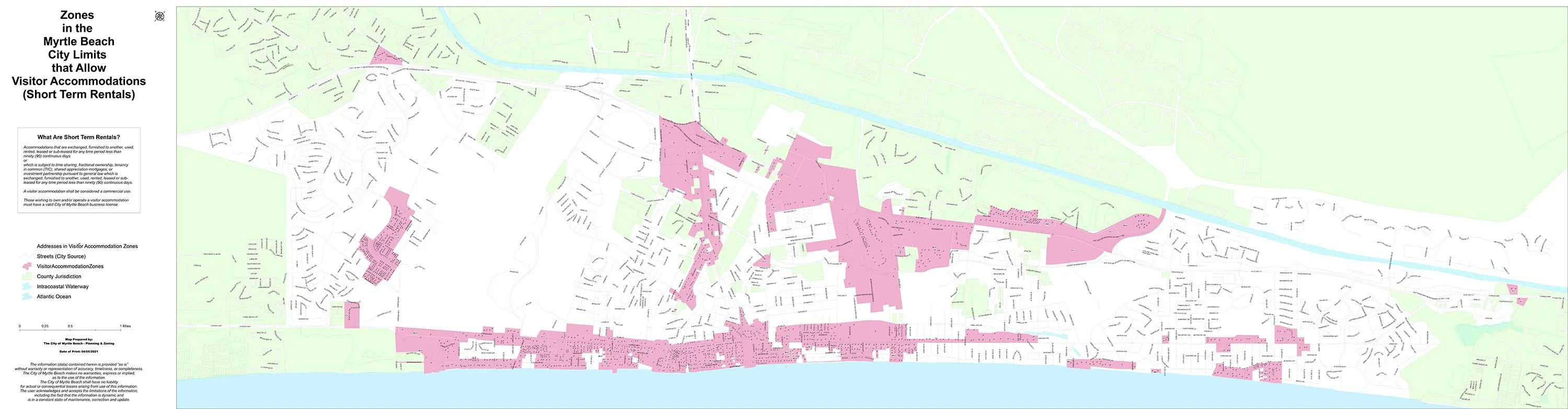
The map is a quick way to see where short-term rentals can and cannot go. It is not a parcel-level answer, so use it to narrow your search, then confirm the exact address with the steps below.
How do you confirm a specific parcel?
Work through these steps for the exact address:
- Look up the address on the city's interactive GIS zoning map and compare it with the short-term rental zone map.
- If the district does not begin with R, check the Zoning Code's permitted-use table under “visitor accommodations.”
- Call the city with the address. For a specific property, Planning and Zoning is at 843-918-1050, and the Zoning Division is at 843-918-1179.
- Read the HOA covenants, condo documents, and deed restrictions. They can rule out short-term rentals even where city zoning allows them.
If you want the answer on paper, the city accepts Freedom of Information Act requests for documents such as zoning verification letters.
Do not assume the neighborhood answers the question. Two homes a short walk apart can sit under different rules.
Which Rules Apply: City of Myrtle Beach, North Myrtle Beach, or Horry County?
Listings and ads often describe homes as being in the “Myrtle Beach area.” That phrase can cover several different governments:
- The City of Myrtle Beach.
- North Myrtle Beach.
- Surfside Beach and other nearby towns.
- Unincorporated Horry County.
Each one sets its own rules, licenses, and local taxes. City of Myrtle Beach zoning does not carry over to a North Myrtle Beach or county parcel. Even the county's hospitality fee changes with location: Horry County charges 1.5% on short-term accommodations inside city limits and 3% outside them. Confirm which government actually covers the address before you rely on any rule.
When you research Horry County or North Myrtle Beach short-term rental regulations, read older articles carefully. A proposed ordinance is not the same as an adopted rule. The adopted code and a conversation with staff are what count.
Do You Need a Business License for a Myrtle Beach Vacation Rental?
Yes. City Council adopted a business license ordinance on June 10, 2014, effective June 1, 2015, that requires a business license for all rental properties: short-term, long-term, residential, and commercial.
Here is what the city's Business License Division says owners should expect:
- Zoning comes first. Every application is reviewed by the Zoning Administrator to confirm the business can exist at that location, and the city will not issue a license if the location is not zoned for that use.
- Other reviews may apply. Depending on the business, Fire, Building, and other departments or state agencies may also review the application.
- It takes time. In-person applications generally take 7 to 10 business days, and mail-in applications can take up to two weeks. You will not leave with a license the same day.
- The fee is based on gross receipts. For a new business, it is calculated on estimated gross receipts from the first day of operation through May 31.
- Each location needs its own license. A separate license is required for each place of business.
- Licenses do not transfer. If you buy a home that is already licensed, the license does not come with it, so plan to apply in your own name.
- Display it. The ordinance requires the license to be conspicuously displayed.
- Renew every year. Renewals are due by April 30, and renewals received or postmarked May 1 or later carry a 5% penalty for each month or partial month until paid.
The city also lists other reasons it will refuse a license, including an incomplete application, unpaid prior license fees, an existing ordinance violation, or unpaid city taxes or fees.
You can apply in person at the City Services Building, 921 North Oak Street, by mail, or online. Questions go to the Business License Division at 843-918-1200 or buslic@cityofmyrtlebeach.com.
Submitting an application is not the same as permission to begin hosting. The city assesses a 5% penalty per month for opening a business before obtaining a license.
What Taxes and Fees Apply to Myrtle Beach Short-Term Rentals?
Zoning and licensing tell you whether you can operate. Taxes are a separate responsibility, and they apply to every booking of less than 90 consecutive days.
State sales and accommodations tax
The South Carolina Department of Revenue (SCDOR) taxes short-term accommodations at:
- 5% state sales tax.
- 2% state accommodations tax.
- Any local sales and use tax that SCDOR collects on behalf of the county.
If you book guests directly, SCDOR requires a Retail License to file and pay accommodations tax. Required cleaning fees are taxable at the same 7% plus any local tax. Optional cleaning fees are not. Service fees charged by a property manager or online travel company are also part of the taxable rental cost.
City local accommodations tax and hospitality fee
Inside Myrtle Beach city limits, short-term rental providers collect and pay the city:
- 0.5% local accommodations tax.
- 1% hospitality fee.
These are paid to the City of Myrtle Beach, not to SCDOR. Returns are monthly, or quarterly on request, and are due on the 20th day after the reporting period ends. You file a return for every period, even one with no rentals. Late payments carry penalties: 2% per month on the local accommodations tax and 10% on the hospitality fee.
Horry County hospitality fee
Horry County charges its own hospitality fee on short-term accommodations: 1.5% inside city limits, including Myrtle Beach, and 3% in unincorporated areas. The county says businesses inside city limits must register with both SCDOR and their municipality.
Taken together, a booking inside Myrtle Beach city limits carries 10% in state, city, and county charges before any county local sales tax that SCDOR collects.
Platform bookings vs. direct bookings
SCDOR's rule is that whoever books the stay collects and pays the state tax. If an online travel company takes the reservation and the payment, it is responsible for the state tax on the full booking. Rentals you book yourself are your responsibility.
One detail catches many owners: if you hold an active Retail License, SCDOR expects a return every period, even when every booking came through a platform or a property manager. In that case you report zeros.
Before your first booking, confirm:
- Which taxes each booking channel collects and remits for you, at the state, city, and county level.
- Which filings remain with you or your manager.
- Which records you need to keep for audits and license renewals.
A tax line on a guest's receipt does not mean every obligation has been covered. A qualified tax professional can review your setup.
What Else Do You Need Before Hosting Guests?
Beyond zoning, licensing, and taxes, plan for:
- Rental paperwork: The city's Documents Center includes a Short/Long Term Rental Affidavit and Ordinance Packet. Ask the Business License Division which forms apply to your property.
- Insurance: A policy written for short-term rental use, not a standard homeowner policy.
- House rules: Occupancy, parking, trash, and noise expectations that guests can actually follow.
- Local response: Someone nearby who can answer the phone and get to the home when something comes up.
That last point matters most for owners who live elsewhere. If a guest reports a problem while you are unavailable, who owns the next step? Our guide for out-of-state vacation rental owners walks through that question in more detail.
What Happens If a Rental Violates Myrtle Beach's Rules?
Violations of the city's zoning code and business license ordinance are misdemeanors. Upon conviction, operating without a business license can bring a fine of up to $500 plus court costs and/or up to 30 days in jail, and each day of violation counts as a separate offense. The city applies the same $500 and/or 30-day limit to each zoning violation.
An active online listing is not proof that a rental is legal. Neither are past bookings or a quiet history with the neighbors.
If you receive a notice, respond promptly. Ask the city to identify the violation, the corrective action it requires, and the deadline. Consult an attorney when needed, and keep your license, zoning correspondence, and tax filings together so you can show the basis for your operation.
Questions to Ask Before You Buy or List
Take these questions to the city, the seller, and your agent:
- Which government regulates this exact parcel?
- What is the parcel's zoning district, and is it in a pink short-term rental zone on the city's map?
- If the home is described as grandfathered, can Planning confirm that in writing?
- Do the HOA, condo, or deed documents restrict short-term rentals?
- Since licenses do not transfer, what will I need to apply for in my own name?
- Which taxes will the booking platforms collect, and which will I file myself?
Specific answers are more valuable than a general assurance that the home “has always been rented.”
Owner Checklist
- Confirm jurisdiction: Identify which local government regulates the parcel.
- Verify zoning: Confirm that short-term rentals are allowed at that exact address.
- Review grandfathered claims: Get written confirmation from Planning.
- Check private restrictions: Read HOA documents, condo rules, and deed restrictions.
- Apply for your business license: Allow 7 to 10 business days, and do not host until it is issued.
- Register for taxes: SCDOR for state taxes, the city for its accommodations tax and hospitality fee, and Horry County for its hospitality fee.
- Arrange insurance: Disclose the intended rental use to your insurer.
- Keep documentation: Save approvals, maps, emails, filings, and renewal dates in one place, and calendar the April 30 license renewal.
If you are buying, complete these checks during due diligence, not after closing.
Start With the Parcel, Then Plan the Rental
A thoughtful vacation rental plan starts with the property's permitted use. Work in the same order every time: jurisdiction, zoning, business license, taxes, then operations. Photos, pricing, and guest care only pay off once the parcel is eligible.
At Leisr Stays, taking care of people is the actual job, and for owners that starts well before the first booking. If you are still weighing what management could look like, our Myrtle Beach property management guide covers services, fees, and questions to ask.
Once you have confirmed your property's rental eligibility, talk with our team about your vacation rental management goals.
This article is general information, not legal or tax advice. Requirements and rates change, and property-specific approvals matter. Confirm current requirements with the relevant local government and qualified advisers before you purchase or operate a rental.